Understanding Polymerase Chain Reaction (PCR)
Polymerase Chain Reaction, commonly known as PCR, is a vital cornerstone in the domain of molecular biology. This revolutionary technique allows scientists to replicate a specific segment of DNA, significantly amplifying it to produce millions or even billions of copies. Such amplification is foundational for a myriad of applications that span across diverse fields like genetic research, forensic science, and medical diagnostics.
How PCR Works
The operation of PCR is grounded in its mimicry of the natural DNA replication process. It utilizes a sequence of meticulously controlled heating and cooling cycles, each stage contributing to different aspects of the DNA amplification process. To execute PCR, several core components are indispensable, including the DNA template, primers, nucleotides, and a polymerase enzyme.
Key Components
DNA Template: The heart of the PCR process is the DNA segment chosen for amplification. This segment acts as a template, directing the synthesis of new strands of DNA.
Primers: These are short strands of nucleotides that play a critical role in the PCR process. Primers are engineered to anneal, or bind, to each end of the target DNA region. They effectively serve as the starting point from which DNA synthesis commences.
Nucleotides: Also known as dNTPs (deoxynucleotide triphosphates), nucleotides are the basic building blocks required for the creation of new DNA strands. They are essential components without which the synthesis cannot proceed.
Polymerase Enzyme: The cornerstone enzyme used in PCR is Taq polymerase. Originating from the bacterium Thermus aquaticus, this enzyme is remarkably heat-stable. Taq polymerase synthesizes new DNA strands by adding nucleotides to the primers.
The PCR Cycle
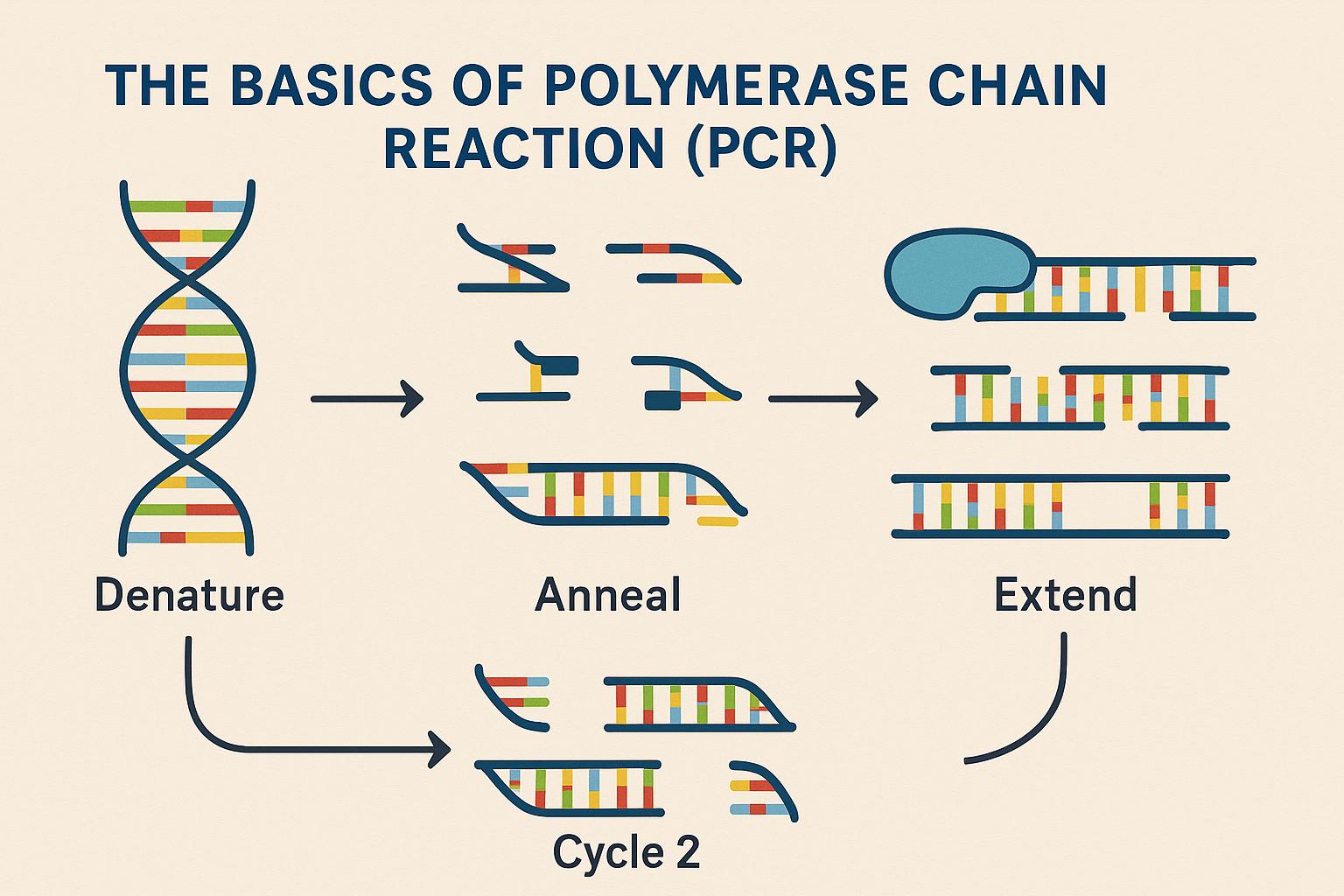
The PCR technique involves a series of repeating steps collectively termed the PCR cycle. This cycle comprises three primary stages: denaturation, annealing, and extension. The execution of a standard PCR cycle involves:
Denaturation: During this initial phase, the reaction mixture is elevated to a temperature range of approximately 94-98°C. This high temperature causes the double-stranded DNA to denature, separating into single strands.
Annealing: The subsequent step reduces the temperature to roughly 50-65°C. At this stage, the primers bind, or anneal, to their specific complementary sequences on the single-stranded DNA.
Extension: The final step raises the temperature to about 72°C. Here, the polymerase enzyme becomes active, extending the primers and synthesizing new DNA strands by sequentially adding nucleotides.
Applications of PCR
The introduction and refinement of PCR have significantly advanced various scientific fields, thanks to its capacity to rapidly amplify DNA. Among its myriad applications, some of the most impactful include:
Forensics: In forensic science, PCR is paramount for enhancing DNA samples collected from crime scenes. This amplified DNA can play a crucial role in identifying individuals, thereby assisting in criminal investigations and judicial proceedings.
Genetic Research: PCR is a powerful tool in genetic research, allowing the investigation of genetic mutations and the analysis of gene expression. Additionally, it is instrumental in cloning genes, thereby contributing to a deeper understanding of genetic structures and functions.
Medical Diagnostics: Within the realm of medical diagnostics, PCR has been transformative. It is employed to detect pathogens, diagnose hereditary diseases, and guide personalized medicine. By identifying specific DNA sequences associated with pathogens or genetic conditions, PCR enables the early diagnosis and tailored treatment of various medical conditions.
PCR’s importance in modern science and medicine cannot be overstated. Its ability to swiftly and efficiently amplify DNA has cemented it as an essential technique across multiple domains, offering profound implications not only for research but also for practical applications in solving real-world problems. In forensic science, PCR aids in bolstering the credibility of DNA evidence, profoundly impacting legal outcomes. In genetic research, it opens new avenues for exploring the vast complexities of the genome. In the medical field, it offers groundbreaking advancements that improve patient outcomes and revolutionize diagnosis and treatment protocols.
The simplicity yet power of PCR lies in its methodological elegance. By harnessing nature’s own DNA replication mechanisms, this process can be replicated with relative ease in the laboratory environment, establishing itself as a reliable and indispensable tool for scientists across the globe. Researchers continue to explore and expand the applications of PCR, and with ongoing advancements in technology, its efficiency and precision are bound to increase, leading to even greater breakthroughs in science and healthcare.
As the realm of biotechnology continues to evolve, PCR remains at its core, a testament to the ingenuity and potential of molecular techniques in advancing our understanding and capabilities within the biological sciences. Whether it is unraveling the secrets of DNA in the human genome or helping to convict criminals by finding matches between crime scene samples and potential suspects, the applicability and significance of PCR ingeniously unify various scientific pursuits under one methodological umbrella.